|
|
|
|
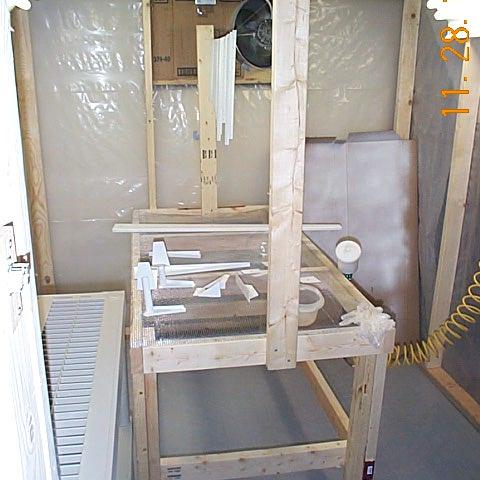
First, let me say right up front, I HATE PRIMING. I don't like anything about it!! I don't like thinking and obsessing about it. I don't like having to plan for it during the construction process (and it must be planned for here in Chicago). I don't like mixing the stuff. I don't like trudging the parts out of the shop to the spray area (outside on the grass). I don't like wearing a mask that scares my cat. I don't like spraying the parts. I don't like turning the parts over. I don't like smudging the freshly painted parts when I turn them over. I don't like too much primer that causes runs. I don't like too little primer (that makes me think I should re-prime it). I don't like lifting the pieces off the cardboard and having the cardboard stick to them. I don't like having to devise a method to hang parts while I spray. I don't like having over spray all over the place. I don't like having to order a new HVLP spray gun to keep over spray from over spraying. I don't like having to wait for it to dry. I don't like having to cart the painted parts back to the shop area. I don't like spending $95/gal for 2 part epoxy primer. I really don't like starting a job and realizing I didn't mix up enough primer. Or worse, mixed to much and wasted product that cost $95/gal. (that's almost $.75/oz). I really, really don't like cleaning the paint gun, especially when the primer balls up and turns to goop because I used Naptha instead of Lacquer thinner. I don't like trying to clean the primer off my skin and out of my hair. I don't like dealing with my wife because I didn't change my cloths and ruined another good t-shirt especially after she asked me to change my cloths so I wouldn't ruin my shirt. Whew! Did I say I DON'T LIKE PRIMING!! I thought I did. Ron Alexander, of Alexander Aircraft fame, wrote an article that was first published in Sport Aviation. Click on this link to read that article. It covers almost everything you need to know about aircraft painting and lots of information on priming. 12/28/99 - Tonight I got to use my new priming booth for the first time and everything went smoothly. Take a look at these beautiful pieces. If I keep up at this rate I'll want to paint the whole airplane when I'm done! The booth worked like a champ and my wife didn't smell anything upstairs. My new paint dispensers worked great also. I had virtually no waste. I also learned why I was having so much trouble with the cleanup in the past. In previous sessions, I was using Naptha to clean the paint gun and reservoir. It always seemed that the paint would "ball up" and not dissolve very well. It was a real hassle and the gun didn't come very clean. I tried using lacquer thinner tonight and wadda know... the gun came clean right away and I was done in no time! Man, why didn't I follow the directions earlier. Before my kit arrived in 1997, I studied the RV List archives to help learn what I could about the easiest and best method to prime. I learned that if you listened to 20 different people you'd get 20 different answers. Obviously, this wasn't going to be as easy as I thought. I learned that a lot of people liked to use a product called Vari-Prime. Of those that used Vari-Prime, many used different procedures to prep it. I learned that many people thought you didn't need to prime at all because Cessna didn't. I learned that some people used spray cans while other used paint booths and $1000 spray guns. Some people like green primer some people liked yellow. I learned a lot. I obsessed about what product to use and would I do it right. I thought I learned a lot. I didn't learn enough. In 1997 I decided to use Sherwinn Williams R60 G2 w/activator. This is a self etching primer that many said would suit me just fine. Vans uses it on their planes and kits. I also used an etching metal cleaner just to be on the safe side (PPG DX533). I decided I did not need to "Alodine" or condition the parts. My procedures went like this:
Shortly after my first couple of priming experiences, my project was put on hold for about 2 years. Fast forward to present day (Sept 1999). I went back to the archives and one post in particular impressed me with its specific comments and points. The authors comments made me realize that if I was going to prime I should probably prime with a self etching primer that had corrosion protection. Upon further investigation I learned that the Sherwin Williams primer I was using provided no corrosion protection! Yup, says so right there on the data sheet. Hmmmm, what to do now? Here is what I finally settled on. Since the basic color of my plane would be white, I wanted to paint the interior white as well. I decided on PPG DP48 two part Epoxy Primer. PPG has several different numbers for their Epoxy primers from DP40 (green) to DP90 (black). Using the Epoxy primer would afford me the corrosion protection I was after and since I was already using PPG DX533 cleaner/etcher I didn't need any other steps. By using the DP48 (white) primer I can probably get away without having to paint the interior. I've seen several planes where builders have used Marhyde (sp?) only and it looks very nice (if you like gray). What about "Alodine" you ask? Well, I thought about that as well. In fact, I bought some (PPG DX503 aluminum conditioner). "Alodine" is a product that offers some corrosion protection for aluminum by actually creating a corrosion boundary layer. It's a very thin layer and some say that it is sufficient. It makes sense to me. I will be using the "Alodine" in places where I want some protection but I also want the "aluminum look" or I don't think I need to primer. The "Alodine" process is used after etching but before priming. The procedures are just like the etching process. You spray it on, let it set for a few minutes (dwell) (do not use scotchbright pad), then rinse it off. "Alodine" comes in either clear or gold color. I prefer the gold color because I think it looks nice and I can see what I'm doing. One of the best looking airplane interiors I've ever seen belonged to a guy in Minnesota. I saw his plane at an RV Picnic here in the Chicago area around 1996 or 1997. It was a deep blue color and he did not have any paint or primer on the interior. Instead he used a clear "Alodine" and used the Scothchbrite pad to give all the interior panels a "brushed metal" look. Very, very attractive. He did, however, use primer on all points where the skin came in contact with bulkheads. The bottom line is this. I prime because it "seems" like the right thing to do, not necessarily because I need to. In my mind I know I've given this subject to much thought. I could probably get away with priming just the non-alclad parts and have a fine airplane that would last as long as I will. I plan on hangering the plane anyway. If you are going to prime then you might as well prime correctly and use the right product. If you are not going to prime, then don't worry about it, your plane will probably fly just fine and for a long time. Below is the RV List message from a guy named Curtis that I think gives the best overview and facts about primer. Doug Weil on the RV List has also got some excellent advice. Do a search on "Doug Priming" you'll get more information than you'll know what to do with.
|